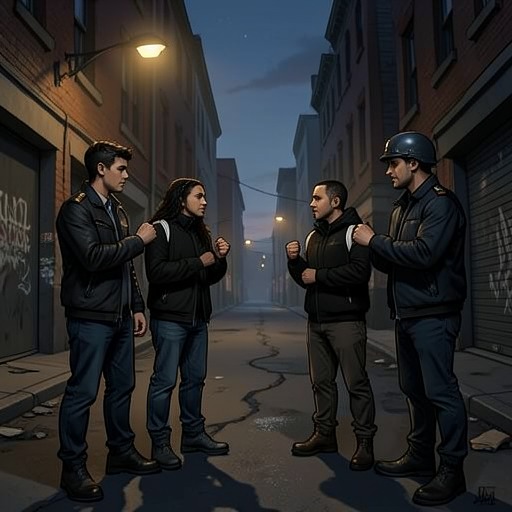
Bernardo
West Side StoryBernardo is the leader of the Sharks, Maria’s older brother, and a forceful advocate for his Puerto Rican community’s claim to a neighborhood already dominated by the Jets. His protective loyalty to his family and his ambition to gather the Sharks around him coexist with a readiness to answer insult with violence. In the confrontation that ends his life, those commitments converge: he provokes Tony Wyzek, fights Riff Lorton, kills Riff, and is then killed by Tony.
Identity and place in the neighborhood
Bernardo’s standing is defined by leadership. The Sharks look to him in their conflict with the Jets, and he acts not only as an individual combatant but as someone who can direct the group. Riff’s hostile account of him frames him as one of the first Puerto Ricans to move into the neighborhood and as a leader intent on bringing other Puerto Ricans onto territory the Jets consider theirs. That account is explicitly shaped by the Jets’ racial hostility: their fear of losing control becomes a story about displacement, in which Bernardo’s community is cast as an invading force.
The wider setting gives that territorial struggle a material pressure. Manhattan’s West Side is described as crowded, deteriorating, and difficult for ordinary residents to leave; affordable housing is scarce, and landlords can profit by subdividing apartments and neglecting their buildings. The neighborhood’s residents have little voice in decisions affecting them. Against this background, Bernardo’s effort to assemble the Sharks is more than a contest between rival leaders, even as the novel shows how a claim to community can be expressed through coercion and gang violence. The wider city treats the Puerto Ricans as a convenient target, while the gangs’ violence helps keep the underlying conditions unresolved.
Leadership and retaliatory violence
Bernardo’s leadership depends on a readiness to make threats credible. After a Jet throws a stink bomb into Guerra’s grocery store, he says that if he catches the person responsible, the offender will lose the use of his arms. Asked whether he knows who did it, Bernardo dismisses the distinction: the culprit is a Jet, and whichever member of either gang is caught first will pay. Personal identification gives way to collective reprisal. His answer makes the logic of the gang war plain: an individual offense becomes a reason to punish the opposing group, and the expectation of reciprocal retaliation keeps the conflict moving.
That logic also shapes the way Bernardo approaches the planned confrontation with the Jets. When he sees Tony arrive at the snack bar, he brings him in and pointedly presents him to Riff as the Jets’ leader, intending to humiliate Riff and unsettle the meeting. Tony’s presence complicates the contest between the gangs, but Bernardo uses it to sharpen the insult rather than ease the tension. His status is bound up with the ability to command the room and make an opponent feel diminished.
Family, intimacy, and control
Bernardo is Maria’s brother and considers her safety his responsibility. At the dance, when he sees her with Tony, he warns Tony to stay away from his sister. He also challenges Maria’s explanation that Tony has done nothing wrong, treating Tony’s association with the Jets as enough to make him dangerous. His concern is genuine, but it arrives as an order: he assumes the authority to decide which men may approach her and what she should understand about them.
At home, Bernardo’s protective role is entangled with a more controlling manner. When Maria arrives after being called, he remarks that she would have come sooner if Tony had summoned her. During the exchange, he reaches as though to pinch Anita Palacio’s chest and teases her about whether she has reason to complain. Anita defends Maria and pushes back against Bernardo’s impatience. Later, when she opens the shop door, Bernardo answers her intimate greeting with a wink before returning to a neutral expression. Their gestures establish a close, playful intimacy, but the scene also places that ease beside his habit of asserting authority over the women around him.
Maria’s challenge to Bernardo is not simply a defense of Tony as a suitor. When he and Chino Martin discuss work and the possibility that a white American might advance in a union ahead of Chino, Maria objects to Bernardo’s hostility and insists that Tony is not a foreigner merely because he is called a Polish name. In her view, anyone who chooses to live in America belongs there as an American. Bernardo answers by suggesting that Tony sees Maria as an easy target because she is Puerto Rican. The disagreement exposes their opposed interpretations of belonging: Maria argues for inclusion, while Bernardo expects racial prejudice and reads intimacy across the divide as a danger to her.
The fatal confrontation
At the meeting with the Jets, Bernardo sees Tony enter and uses him to mock Riff. As the confrontation develops, Bernardo taunts Tony, treats his refusal to fight as cowardice, and slaps him. Riff, who has spent weeks and months defending Tony against criticism from members of the Jets, reads the humiliation as an assault on his friend and on his own pride. He reaches for his knife and attacks Bernardo, turning the standoff into the fight both gangs have been anticipating.
Bernardo knocks Riff off balance and draws his knife. He orders the Sharks to stay back, choosing to face Riff himself. The two leaders circle and feint with their knives, each aware that such a fight may be decided in only a few strokes. When Tony breaks free from the Jets holding him, Riff cries out for him to retreat and gestures broadly with his arm. Bernardo seizes the opening: he lunges and drives his blade into Riff’s chest, just below the heart. Riff is dead before he reaches the ground.
Tony then picks up the knife from Riff’s limp hand and charges Bernardo before Bernardo can position himself to defend. Tony’s blade enters Bernardo’s side, and Bernardo collapses, mortally wounded. Police sirens arrive as the surviving Jets and Sharks scatter. In the immediate aftermath, Tony flees with Diesel, crying Maria’s name while the sirens answer him. The rapid exchange of deaths leaves no victory for Bernardo’s leadership: the killing he commits is followed at once by his own death and by the collapse of the people and loyalties around him.
Narrative significance
Bernardo is neither only a protective brother nor only a gang leader. His attachment to Maria and Anita is visible in moments of intimacy, but his protection of Maria takes the form of suspicion and control; his defense of his community gives voice to real pressure, but it also becomes a license for threats and retaliation. The novel makes those impulses inseparable from a neighborhood where residents feel abandoned and where the gangs supply both a sense of agency and a new source of danger.
His death is the turning point that transforms the gang conflict into an intimate catastrophe. Bernardo’s knife kills Riff; Tony’s response kills Bernardo; and Maria learns that Tony has killed her brother. The sequence binds the conflict’s public divisions to private grief, while showing how a retaliatory code makes each act of loyalty produce another loss. Bernardo’s final role is therefore double: he is a powerful participant in the violence, and one of the people it consumes.